In my previous post Bye Bye Zoe, I talked about my last car, which was an electric car (a Renault Zoe) and how I had got it on a lease as an experiment to see how viable EVs were for me and to understand what it was like to own and use one.
That three-and-a-bit year long experiment came to a conclusion last week when the lease company came to take the Zoe back.
Since I posted it, I've had a few people ask me what I got to replace it. Did I go back to an ICE car?
The day my Zoe was taken away, my new car was delivered. I have it on a lease again for a number of reasons, but this will be the car I drive for the next 3 years or so.
And here it is, a shiny new BMW i3:
As you can see, it's another EV.
You see, three years of driving in the Zoe has made me realise how unpleasant and clunky ICE cars are. EVs are quiet, clean, and a pleasure to drive. And I really do not miss the visits to the petrol station.
So, why the BMW? The main reason was that the lease cost of the BMW, despite it being a more expensive car, was actually slightly cheaper than the Zoe. This is because lease costs are largely based on residual values of the vehicle at the end of the lease, and the BMW retains it's value more than the Zoe.
And, yes, I have it on a lease. The way I look at it, this stimulates EV usage. A huge number of the second hand cars on the road come are ex-fleet or lease cars. Most people don't get brand new cars and one of the complaints that I hear about EVs is that there are few "affordable" ones, by which people mean they can't get a second-hand one easily. People like me getting EVs on a lease eventually expands the pool of second-hand EVs in the long term.
Another point is EV technology is still in a relatively early phase of development. My new car has around twice the range of my old Zoe. In three years time, the battery technology is likely to improve significantly.
Plus it means I get a shiny new car every 3 years or so.
The BMW is a lovely car. I do miss the speed limiter that the Zoe had (the cruise control really isn't the same thing) and the passenger doors take a little getting used to, but in the week I've had it I'm very impressed so far.
The ride is comfortable and, if anything, it's even quieter than my Zoe was; I think the acoustic insulation against road/wind noise is superior. It's also a pocket-rocket! My Zoe was really responsive and quick-off-the-mark, but the i3 has noticeably better acceleration.
I also have the petrol range-extender. This is a onboard petrol generator, fed from a 9 litre tank, which kicks in when the battery is low to keep it charged. It can extend the range by around 70 miles and, of course, you can pop into a petrol station to refill it. I don't anticipate using it very much, but it's there if I need it. Again, the residual values factor meant the lease for the range-extender version was no more than the non-range-extender version.
One thing I love about the BMW is the remote control actually works!
The Zoe had the ability to check charge status and level, and to remotely set the preconditioning to heat or cool the car before a journey, but it never worked properly. The charge indicator worked, but it had an update resolution of about 20 minutes, which is useless when a charge may only take 30 mins. I could schedule or turn on preconditioning from the app, and it seemed to work, but the car never preconditioned.
The BMW app actually works. The charge status is relatively up to date, and the preconditioning (and other controls) show you the status, including communication with the car, so if it fails you know. You can also GPS locate the car, which is useful if you have parked in a large car park.
The bluetooth also works well. The Zoe bluetooth used to cut off the first few seconds of audio. In the last few months I've been using Android Auto with my phone. The bluetooth issue on the Zoe made it tricky to use as you always lost the first second or two of the audio responses. The BMW doesn't have this flaw.
However, I am a bit pissed off that BMW have withdrawn their plans to natively support Android Auto. Apparently it's because they want to "control the whole experience". What this actually means is they have committed themselves to a path of legacy, out of date infotainment systems. It's a shame as I would have happily paid them for an Android Auto add-on application.
One nice thing is that, when I have my phone connected, the voice control button activates Android Auto voice search, so I don't need to shout "OK Google" at it.
I will continue to use Android Auto on my phone and relegate the BMW infotainment system to being a bluetooth receiver.
Showing posts with label Electric Vehicles. Show all posts
Tuesday, 27 June 2017
Monday, 26 June 2017
Bye bye Zoe
Last week they came to collect my Renault Zoe electric car. The lease period ended a few months ago, and I had extended it for a few months until I had arranged the replacement.
I got the Zoe as a bit of an experiment, at a time when EVs were a bit of an unknown. I wasn't doing much mileage and we had another ICE car to use. I wanted to see if living with an EV was possible and sensible (for me) and also to gain an understanding of the issues and what is involved in EV ownership.
I'm glad I did it. I learned a lot.
In the last 3 1/2 years I did approximately 24.5k electric miles. Most of these miles were journeys of 20 miles or less. I probably did no more than 5 or 6 journeys of more than 100 miles in the car in that time. Partly because on the occasions we had longer journeys we used the ICE car. But those occasions were few and far between.
I've come to understand that "range anxiety" is hugely mitigated by home charging. Basically, despite having a limited range, my car was almost always full without me having to search out a fuel station. In fact, I remember having "range anxiety" far more often and regularly with my old ICE car.
I also got out of the habit of getting fuel for an ICE car, so on the few occasions in the last 3 1/2 years I've had to fill up an ICE vehicle, I found it was no longer something I could do without thinking about it. In fact I had to think quite hard to remember what to do. It all felt quite alien.
Charging an EV can vary from very straightforward to a complete ballache. Most of the time it is the easy, but when you are on a long journey and desperately need a mid-journey charge, and the chargers are all out of action, or are in use or, worse for a different charging network it can be very painful.
The biggest issue is the charging networks. Imagine all the parking lots required you to pre-register and receive a parking card by post before you could use them. You could drive to a new town and find nowhere to park even if you had registered with half a dozen major parking companies. That's what charging is often like. And it's ridiculous!
Why is it EV chargers don't have any way to pay at the charger, even if it's by installing an app and registering a payment card? If I can do that at a random car park, why can't I do it for a charging point?
The other issue is that none of the charging networks have 24x7 support. So if you find yourself stranded at a broken charger at 9pm on a Saturday night, you'll be on your own.
Whilst the charging network in the UK is now massively better than it was 3 1/2 years ago, there's still a long way to go.
On the positive side, I have learned how smelly and uncomfortable ICE cars are in comparison. When you drive an ICE car you get used to the vibrations, and accompanying slight rattles. You stop noticing the subtle, but pungent smells of petrol, oil, antifreeze, etc. You get used to the noise of the engine. But these are all noticeable and, to me, distinctly unpleasant, to an EV driver after a few months of using an EV.
The drive quality in EVs is also noticeably smoother and more responsive. When I put my foot down to pull away from traffic lights in my Zoe, it responded immediately. I never noticed until now that even relatively high-performance ICE cars have a slight lag before they respond. The torque and acceleration at lower speeds (under 50 mph) were extremely good also, rivalling most other cars on the road
It was a little sluggish at higher speeds but, frankly, great acceleration at 60 mph is a nice to have. I know people say it's important at higher speeds "to get you out of trouble" but, if they really mean that, they are just admitting they are terrible drivers. In reality, how many accidents are caused by a car not being pokey enough at higher speed? I've never heard of one in all the years I have been a driver.
Talking of speed, one of the things the Zoe had, and which I will really miss, is the speed limiter. I could set set the limiter to, say, 30 mph in a built-up area, and know that I didn't have to worry about speeding. It was interesting how many people would tailgate me when I used the speed limiter, trying to bully me into going faster than the legal speed limit.
I had a bit of a love/hate relationship with the Zoe in-car navigation and entertainment system. It had no DAB (which for a car of it's era is strange) and the navigation system was a Tomtom variant, which worked OK, but was nowhere near as good as Waze or even simple Google Maps navigation. I find Tomtom to have a really clunky user-interface which requires far too many keypresses on a sluggish screen to be anything but frustrating to anyone who has used a modern sat nav system. It's also, IMO, dangerous to use when driving. Arguably, of course, you shouldn't mess with any sat nav when driving, and the Zoe Tomtom does give you warnings to not use it unless parked, but there are times when you really need to reroute, or do some other small route tweak, and the Tomtom really requires far too many focussed key presses.
But overall, I loved my little Zoe. It was a joy to drive, cheap to run, and I never tired of getting into it, even after more than 3 years. The experiment was mostly a huge success, and I'm not sorry I gave it a go.
But now the Zoe has to go back and it's time for a new car. I will miss it.
I got the Zoe as a bit of an experiment, at a time when EVs were a bit of an unknown. I wasn't doing much mileage and we had another ICE car to use. I wanted to see if living with an EV was possible and sensible (for me) and also to gain an understanding of the issues and what is involved in EV ownership.
I'm glad I did it. I learned a lot.
In the last 3 1/2 years I did approximately 24.5k electric miles. Most of these miles were journeys of 20 miles or less. I probably did no more than 5 or 6 journeys of more than 100 miles in the car in that time. Partly because on the occasions we had longer journeys we used the ICE car. But those occasions were few and far between.
I've come to understand that "range anxiety" is hugely mitigated by home charging. Basically, despite having a limited range, my car was almost always full without me having to search out a fuel station. In fact, I remember having "range anxiety" far more often and regularly with my old ICE car.
I also got out of the habit of getting fuel for an ICE car, so on the few occasions in the last 3 1/2 years I've had to fill up an ICE vehicle, I found it was no longer something I could do without thinking about it. In fact I had to think quite hard to remember what to do. It all felt quite alien.
Charging an EV can vary from very straightforward to a complete ballache. Most of the time it is the easy, but when you are on a long journey and desperately need a mid-journey charge, and the chargers are all out of action, or are in use or, worse for a different charging network it can be very painful.
The biggest issue is the charging networks. Imagine all the parking lots required you to pre-register and receive a parking card by post before you could use them. You could drive to a new town and find nowhere to park even if you had registered with half a dozen major parking companies. That's what charging is often like. And it's ridiculous!
Why is it EV chargers don't have any way to pay at the charger, even if it's by installing an app and registering a payment card? If I can do that at a random car park, why can't I do it for a charging point?
The other issue is that none of the charging networks have 24x7 support. So if you find yourself stranded at a broken charger at 9pm on a Saturday night, you'll be on your own.
Whilst the charging network in the UK is now massively better than it was 3 1/2 years ago, there's still a long way to go.
On the positive side, I have learned how smelly and uncomfortable ICE cars are in comparison. When you drive an ICE car you get used to the vibrations, and accompanying slight rattles. You stop noticing the subtle, but pungent smells of petrol, oil, antifreeze, etc. You get used to the noise of the engine. But these are all noticeable and, to me, distinctly unpleasant, to an EV driver after a few months of using an EV.
The drive quality in EVs is also noticeably smoother and more responsive. When I put my foot down to pull away from traffic lights in my Zoe, it responded immediately. I never noticed until now that even relatively high-performance ICE cars have a slight lag before they respond. The torque and acceleration at lower speeds (under 50 mph) were extremely good also, rivalling most other cars on the road
It was a little sluggish at higher speeds but, frankly, great acceleration at 60 mph is a nice to have. I know people say it's important at higher speeds "to get you out of trouble" but, if they really mean that, they are just admitting they are terrible drivers. In reality, how many accidents are caused by a car not being pokey enough at higher speed? I've never heard of one in all the years I have been a driver.
Talking of speed, one of the things the Zoe had, and which I will really miss, is the speed limiter. I could set set the limiter to, say, 30 mph in a built-up area, and know that I didn't have to worry about speeding. It was interesting how many people would tailgate me when I used the speed limiter, trying to bully me into going faster than the legal speed limit.
I had a bit of a love/hate relationship with the Zoe in-car navigation and entertainment system. It had no DAB (which for a car of it's era is strange) and the navigation system was a Tomtom variant, which worked OK, but was nowhere near as good as Waze or even simple Google Maps navigation. I find Tomtom to have a really clunky user-interface which requires far too many keypresses on a sluggish screen to be anything but frustrating to anyone who has used a modern sat nav system. It's also, IMO, dangerous to use when driving. Arguably, of course, you shouldn't mess with any sat nav when driving, and the Zoe Tomtom does give you warnings to not use it unless parked, but there are times when you really need to reroute, or do some other small route tweak, and the Tomtom really requires far too many focussed key presses.
But overall, I loved my little Zoe. It was a joy to drive, cheap to run, and I never tired of getting into it, even after more than 3 years. The experiment was mostly a huge success, and I'm not sorry I gave it a go.
But now the Zoe has to go back and it's time for a new car. I will miss it.
Monday, 13 July 2015
EV Update, June 2015
It's been well over a year now since I had my Renault Zoe EV delivered. I've blogged about it several times since then, but I thought I was well overdue for an update.
General
Whilst, after more than a year of use, I've largely got used to the Zoe, I still find myself marvelling at the whisper quiet, gliding ride and the wonderful responsiveness. This is, usually, after spending a short time driving our other car, a smoky, chugging diesel guzzling Grand Scenic.
In fact my wife now takes any opportunity to steal my car instead of driving the diesel.
I'm now used to plugging it in, and the tools to find charging points are improving all the time, as is the availability and reliability of charging points.
An example Journey
A few months ago I met my daughter at Westfield Stratford which required a drive to the other side of London. If we are driving the Grand Scenic we would normally drive around the M25 because, although the traffic is often fairly nasty, it's a nicer drive than crawling along at 20mph through London in a car with a manual gearbox: that can really takes it's toll on your clutch foot!
I chose to take the Zoe instead for this trip. If I had gone around the M25 I wouldn't have had the range and would have had to stop for a charge in each direction. Instead I decided to take the shortest route recommended by the satnav (accounting for traffic) which was straight through the centre of London. This was slow, but on balance it was only about 10 mins slower than bombing around the M25 in the diesel car. Also, as there's no gear changes to make in the Zoe, it was a comfortable drive. Furthermore, the active air filtration and ionizer in our "Zen" edition model kept the pollution out.
When we arrived at Westfield Stratford we still had 40 miles range left "in the tank", and I simply plugged into one of the fast chargers in the Westfield car park for a free charge so I was at 100% (with an estimated range of over 100 miles) when it was time to go home.
Charging Stats
I recently checked some of my charging stats. My home charging unit was fitted by, and is monitored by, +Chargemaster Plc who also operate an extensive network of charging points across the country. As part of their service they provide statistics on your usage of your home charger, and of the charging network.These statistics are from my first ever charge on 23rd Jan 2014 to today, 13th July 2015. They are for the Chargemaster network only. I have also used other networks including +Ecotricity (who operate rapid chargers up and down the motorway network) and Source London. In particular I have used the Ecotricity charge points quite a bit. Unfortunately neither of these other networks provide usage stats.
![]() |
| Summary of Charging |
This represents approx 12,700 miles of driving at an average of around 3.8 miles per KWh.
As you can see, the saving is pretty good.
As a further breakdown, 98.6% of my charges (representing 98.1% of the electricity used for charging) were done from home. These figures, especially the electricity usage one, may vary a bit if the Ecotricity chargers could be included as many of the times I have used one of their rapid chargers, I have charged 60% or more.
But what it does show is that home recharging is key, at least for my use and I would consider my usage fairly typical.
Some of my usage of other chargers is, frankly, not that essential but I use them where they are available (and free to use) as it's a nice perk of being an EV driver. For instance, one of my local Waitrose supermarkets has a free charger (Chargemaster network) and I quite often plug into that to get a top-up whilst shopping and I know of other EV drivers who use this particular supermarket simply because they can get a few free kWh.
For supermarkets and other locations such as hotels, I see availability of free or low-cost EV chargers as being an increasing competitive advantage for them.
Sunday, 1 June 2014
Fuel "Economies"
The "Hydrogen Economy"
In discussions about the future of vehicle energy, I often see people talk about "The Hydrogen Economy".The use of this term clearly indicates that the person using it is focussing on the commercial and financial aspects of energy supply rather than on any of the other aspects. They are looking at how companies and, by association, those in Government can commercially exploit future energy supply. They are looking to how profits can be made, taxes levied, and empires built or maintained.
This concerns me because, although the health of the economy is important, it's by far not the only issue at stake. In fact I would say it was the least important one, because it will take care of itself.
Whatever our future energy supplies look like, there will be companies making money from that energy supply, and this can support a thriving economy. What frightens people is that it may not be the same companies as the ones that control the market today. In fact it's entirely possible we fuel our vehicles of the future from a mix of suppliers as well as self-generating much of our own energy.
This scares the hell out of the established petrochemical companies, as it erodes their traditional near-monopoly control over the market, and their influence with Governments. And there are already signs it is starting to happen:
Why the Oil Industry is Running Into Major Trouble
The Oil Economy
It's worth pointing out that we currently live in an "Oil Economy" which is largely run under the control of a handful of large corporations and Governments. It's fairly clear to everyone except the wilfully ignorant that the invasion of Iraq (and, probably, the war in Afghanistan) was not about terrorism, 9/11, threat of attack, WMDs, or mistreatment of their civilian populations. It was about oil.More specifically, the attack on Iraq was most likely about protecting the Petrodollar: currently most trading in oil is done using the US dollar and it is largely this which makes the dollar a strong currency and, to a degree, makes America rich and powerful. Saddam was was hugely influential in the Middle East, and was leading the way to switch the trading currency away from the US dollar to the Euro (see Saddam Turns His Back on Greenbacks). This could have been devastating to the US economy. Many observers believe this could have been the main catalyst behind invading Iraq.
What is clear is that "the oil economy" is so powerful and influential that protecting it can drive Governments to start wars that kill thousands of it's own citizens, as well over 100,000 enemy civilians, and which cost trillions of dollars.
The current oil economy is bad for us as citizens and as consumers. It is an abusive, corrupt, and murderous model that exploits us as consumers, corrupts our Governments, and makes small fortunes for corporations and the handful of people that run or, in the case of politicians, are run by them.
So what's really happening?
When people talk about "The Hydrogen Economy", what is really happening is that the companies who currently control "The Oil Economy" are trying to find a new business model to transition to, to maintain their power and influence.They are promoting hydrogen as a fuel because it maintains a large part of their monopoly control of the fuel supply chain. It maintains the population's dependence on their product. And it's possible to use misdirection and lies to make it sound like a cheap, abundant, clean and renewable fuel when it is actually none of these things.
The reality is somewhat different. As it stands today, a "Hydrogen Economy" is bad for the environment, and bad for us as citizens.
So when someone talks about "The Hydrogen Economy", I see someone whose main concern is support for maintaining the continuing dependence on, and control of the economy by, the oil companies and their cronies.
Whose primary concern is how they can exploit us as a consumers to line their own pockets and to maintain power and influence.
Monday, 19 May 2014
Car deaths
I learned something interesting today: it seems that pollution caused by ICE cars causes more deaths per year in the UK than road accidents.
These are rough figures, and I got them from various sources such as these:
Estimates of mortality in local authority areas associated with air pollution
Reported road casualties in Great Britain: main results 2012
But the summary is:
25,000 deaths in the UK per annum are attributed to pollution. Roughly 7,000 are directly attributed to small particles from diesel soot. More are attributed to various other pollution causes which aren't so easy to tie directly to road vehicles, but a good proportion of early deaths due to carbon monoxide, nitrogen dioxide, and other poisonous substances including hydrocarbons is likely to come from the tailpipes of cars, lorrys and other ICE vehicles.
Compare that to the number of deaths in road accidents, which is less than 2,000 per annum.
It's a sobering thought, especially if you live or work in a major city where the pollution levels are high.
These are rough figures, and I got them from various sources such as these:
Estimates of mortality in local authority areas associated with air pollution
Reported road casualties in Great Britain: main results 2012
But the summary is:
25,000 deaths in the UK per annum are attributed to pollution. Roughly 7,000 are directly attributed to small particles from diesel soot. More are attributed to various other pollution causes which aren't so easy to tie directly to road vehicles, but a good proportion of early deaths due to carbon monoxide, nitrogen dioxide, and other poisonous substances including hydrocarbons is likely to come from the tailpipes of cars, lorrys and other ICE vehicles.
Compare that to the number of deaths in road accidents, which is less than 2,000 per annum.
It's a sobering thought, especially if you live or work in a major city where the pollution levels are high.
Sunday, 11 May 2014
Coupling
A programmers brain
I am a Software Engineer.(It's not my primary job, but an important secondary capability which massively enhances my ability to do my normal primary role)
One of the things about Software Engineers, Developers, "coders", is the way they think, the way they analyse things. To me, this is one of the primary reasons why everyone aught to learn how to code: not because everyone needs to be able to code, but because it teaches analytical thinking. And much of the analysis that applies to Software Engineering also applies to real life too.
Fuel supply: tight and loose coupling
Since owning an EV, I've been analysing many of the aspects of EV ownership and long term strategy. I've also had many discussions and debates with people who are for, and against EVs. Many of these discussions end up focussing on fuel consumption, and the fact that EV's are not completely "clean".It is, of course, completely true that most EVs, including mine, consume electricity generated from fossil fuel. In one discussion I had someone said "so the argument for EVs over ICE cars is about which is consuming fossil fuels more efficiently?"
He has a point. However, that view is focussing on just one aspect of EVs, and this is where my developer brain kicks in.
In Software Engineering, there is a concept of "coupling" which, basically, describes how closely dependent different parts of a system are with each other. If a system is highly dependent on other parts then it is "tightly-coupled" with them. If it is not so dependent on them then it is "loosely-coupled".
Writing software where subsystems are tightly-coupled with other subsystems is almost always considered to be bad practice. Software like that tends to be difficult and expensive to maintain and to change. Good software should be written to be loosely-coupled with other systems as much as possible.
This applies with hardware too: it's much better to have every phone use a common charging connector standard than for every phone to have their own proprietary connectors. Of course, what is good for the consumer and the environment isn't always in the best interests of companies, and some companies will deliberately make their software and hardware proprietary to lock consumers into their ecosystem. Microsoft and Apple are prime examples of this.
There is a strong analogy here with cars and how we fuel them. The status quo is that we have an ecosystem that has been developed over almost a century which drills for oil, delivers it to refineries, processes it into petroleum and other fuels, distributes it to filling stations, and then dispenses it to customers. Every stage of that ecosystem is highly dependent on all other stages, and when we use a petrol or diesel car we are highly dependent on it.
It is a very tightly-coupled ecosystem. Of course this whole ecosystem has evolved out of necessity more than design.
EVs still, mostly burn fossil fuels. The big advantage with electricity as a fuel is that electricity is loosely-coupled to the fuel supply. Electricity can be generated from burning oil, but also from coal, gas, nuclear, hydrogen, wind, solar and wave power, as well as who-knows-what in the future. And that is a very important factor because no-one knows yet what the long-term future of our fuel supplies will be.
And the other advantage plug-in EVs have over every other type of fuel system is that they are totally de-coupled from traditional suppliers: you can charge your EV from solar panels on your roof if you want.
(Of course, I realise that no everyone can install solar panels, but the point is valid even if it doesn't apply universally).
Put another way:
A petrol engine uses 100% fossil fuel and always will always use 100% fossil fuel, because it is tightly coupled to that specific fuel and to the supply chain that provides it.
An electric car may use 100% fossil fuel in the very worse case (and even then it uses less fossil fuel per mile than most ICE cars), but more normally significantly less than 100% of an EV's fuel consumption comes from fossil fuel (currently in the UK more than 10% is from renewable sources) and the percentage of fossil fuel used by EVs is decreasing all the time.
But it also gives us a choice: if we are prepared to invest in it, individually we can increase that percentage dramatically through the choice of electricity supplier, or the use of local (e.g. solar) generation to the point where 0% of the power from our EV comes from fossil fuels. And the more we do this as individuals, the more the power companies will move away from fossil fuels towards renewable energy sources.
What about biofuels
There was a lot of excitement about biofuels a while back, and they still have their place today. I know of people who use vegetable oil in their diesel engined cars, for instance.
Where we are today, we are not in a position where mass production of biofuels to the levels needed to supply a significant percentage of cars on the road is practical. That may change in the future.
Of course, being renewable is only one part of the eco-equation. Biofuel vehicles still produce a significant amount of CO2, and also create a significant pollutant health hazard on our streets.
And, if the problems of biofuel production are solved, there's still the option of using biofuel to generate electricity, which is possibly more efficient and less polluting.
The hydrogen argument
And what about hydrogen? The view put forward by Top Gear and the rest of the petrochemical industry is that hydrogen is our saviour. They envision a world where we fill up our hydrogen fuel-celled cars from hydrogen pumps on the forecourts of filling stations, which are supplied, in turn, by huge tankers delivering hydrogen from production facilities.In other words, they want to maintain the same crappy, tightly-coupled, monopoly/cartel controlled supply chain that currently has a stranglehold over us.
But, in actual fact, hydrogen isn't currently a very green fuel; the majority of hydrogen production today is part of the petrochemical process. It consumes non-renewable, fossil fuel just like petrol.
Isn't that convenient? For them!
The fact is the petrochemical industry is running scared over plug-in EVs just as certain monopolistic, proprietary software vendors have been running scared over open source software. The push for pumped hydrogen fuelled cars is a distraction designed to turn people away from EVs.
Of course, there are some potential ways to generate hydrogen which aren't from fossil fuels. But the thing to remember is that hydrogen fuel cells are, fundamentally, a way to generate electricity to power an EV. So why on earth do people think that an EV which is limited to only one source of electricity generation technology, sourced by a historic cartel, and delivered through a legacy supply-chain, is a good thing?
The future, if we want it...
Battery technology has a way to go, but it's advancing rapidly. In the next 5 years, cost effective plug-in EVs with a range of 300 miles could be common. Combine this with a network of rapid chargers, home charging points with smart-metering, and street charging posts (if you can power a lamp-post or a parking meter you can power a charging point) then we could move to a much more flexible, cost-effective, and convenient vehicle fuelling ecosystem.And hydrogen may have a future in this. If renewable, cost-effective ways to generate hydrogen are developed then why not. But I see no reason why hydrogen generation has to be trapped in the current supply chain. If, for instance, we develop a way to harness algae to produce hydrogen, it actually makes most sense to do this locally. Perhaps we even do it in our own homes and use the hydrogen to drive a home fuel-cell unit which provides our home with heat and power, and also charges our EV battery.
Tuesday, 29 April 2014
Thoughts and observations on car energy consumption
I have found that driving an EV can make one much more aware of the amount of energy that propelling a car takes.
Traditionally, fuel for vehicles has been a "thing"; a tangible object that you can purchase and take home with you. It is measured in physical units, such as gallons or litres, or weight (in the case of fuels like coal). When we consume it, we measure the consumption by those same units. Hence we consider "miles per gallon" as a measurement of how efficient our car is.
As a relative measurement (to other cars) this is, of course, fine. As a consumer purchasing the fuel, it also gives us a view on the cost of motoring. However, it tells us nothing about the actual energy consumption, at least not directly or intuitively.
Energy is not measured in gallons or litres. The official SI unit of energy is the joule (J), but the reality is most people don't think in joules, and have no concept of how much a joule is. However, there are a number of other units of energy are commonly used, such as calorie and electronvolt. In the case of electrical power, energy is most often measured in killowatt hours (kWh). A kWh is also known as a "unit" of electricity. Most people have some understanding of kWh (or "units") as it relates directly to the power consumption of various appliances around the home, and to their electricity bill! (for reference, 1 kWh is equal to 3.6 megajoules)
Related to this, we can measure the rate of power use in watts (W). Power is the rate of energy change or transfer with 1 watt being equal to 1 joule of energy per second. In our case we use kilowatts (kW) which are 1,000 watts each.
We know, for instance:
With these as mental benchmarks, if we now look at driving a car. In my EV, driving steadily along a straight, flat road at 30mph, and can easily be burning 10kW. That's equivalent to 10 electric fires, or 5-6 electric kettles!
If I drive at that consumption rate for an hour, I will consume 10kWh of electricity. The maths are simple and obvious and it was quite startling to me how much power is required to propel a small car. If I accelerate, I can easily be burning 30 or 40 kW. That's a lot of power!
As I have shown above, consumption for an EV is easy to work out. It is, of course, significantly different (and more revealing) than for an ICE car. And, instead of mpg, we use mpkWh (miles per kilowatt hour, or per "unit" of electricity). In my example above I burned 10kWh for 30 miles and, hence, I am getting 3 mpkWh from my car. In fact, across a range of journeys which includes everything from edging along in traffic at 5mph to 70+ mph motorway driving, my car gives me 3.8 mpkWh.
Others, who are more careful drivers than me, have achieved in the region of 4 mpkWh in the ZOE.
Of course, this helps us understand car energy consumption in relation to 1 bar fires and electric kettles, but how does it compare with good-old petrol engines? Petrol has a known energy density, and a calculation can be done to work out the amount of energy consumption, but this is rarely done. In general people merrily drive their cars without the slightest clue of how much energy it is consuming.
So let's do that calculation:
(EDIT: A friend of mine, +Francis Chin , pointed out an error in my calculations, so these have been updated)
A UK gallon of petrol typically contains around 156 megajoules of energy (132 MJ for a US gallon). If your car, on average, burns a gallon of fuel every miles (43 mpg) then every mile of travel consumes 1/43th of a gallon. That contains about 3.6 MJ of energy, which is equivalent to around 1kWh of electricity. Thus 43 mpg in an ICE is equivalent to 1 mpkWh in an electric car.
Of course, there are ICE cars with much better consumption than that, but in order to reach my, relatively heavy-footed, 3.8 mpkWh figure, an ICE would need to be 3.8 times better than 43 mpg. It would need to achieve 163.4 mpg!
And that is only considering the energy content of the fuel and ignoring the substantial energy costs of drilling, pumping, refining, and shipping. The energy used for refining alone is pretty boggling (as we shall see in my update below).
In reality even the most efficient ICE available to purchase today cannot reach half of that figure. And, bear in mind, this is real world driving, not some theoretical controlled test.
I also haven't considered cost in any of the above. Let's do that now:
A litre of unleaded petrol in the UK currently costs around £1.30. That is £5.91 per UK gallon. That is a cost of 3.79 pence per megajoule.
A "unit" of electricity in the UK currently costs about 13.5 pence (inc VAT). That is a cost of 3.75 pence per megajoule.
So, electricity is currently roughly the same price for the equivalent energy content.
However, petrol engines, even the most efficient modern ones, are only 35% efficient at best. The engines in electric cars are in excess of 80% efficient (The motor in the Telsa model S is claimed to have an efficiency of 88%). If we take the case most favourable to petrol, and calculate the cost of realising the energy stored in the fuel to an equivalent energy at the wheels, we end up with a cost of 10.83 pence per megajoule for a petrol car, and 4.69 pence per megajoule for an electric car. That's more than twice as much.
And petrol prices are rising faster than electricity prices.
The result of this is that, for an equivalent specification of car, the energy costs are around 3-5 times more for a ICE car than for an EV.
UPDATE (1 May 2014):
I've recently watched the latest episode of Robert LLewllyn's excellent Fully Charged Youtube show. At 4:55 he starts to discuss how much electricity is used to refine petrol.
Traditionally, fuel for vehicles has been a "thing"; a tangible object that you can purchase and take home with you. It is measured in physical units, such as gallons or litres, or weight (in the case of fuels like coal). When we consume it, we measure the consumption by those same units. Hence we consider "miles per gallon" as a measurement of how efficient our car is.
As a relative measurement (to other cars) this is, of course, fine. As a consumer purchasing the fuel, it also gives us a view on the cost of motoring. However, it tells us nothing about the actual energy consumption, at least not directly or intuitively.
Energy is not measured in gallons or litres. The official SI unit of energy is the joule (J), but the reality is most people don't think in joules, and have no concept of how much a joule is. However, there are a number of other units of energy are commonly used, such as calorie and electronvolt. In the case of electrical power, energy is most often measured in killowatt hours (kWh). A kWh is also known as a "unit" of electricity. Most people have some understanding of kWh (or "units") as it relates directly to the power consumption of various appliances around the home, and to their electricity bill! (for reference, 1 kWh is equal to 3.6 megajoules)
Related to this, we can measure the rate of power use in watts (W). Power is the rate of energy change or transfer with 1 watt being equal to 1 joule of energy per second. In our case we use kilowatts (kW) which are 1,000 watts each.
We know, for instance:
- An average electric kettle in the UK draws 1.8kW of power
- A typical washing machine consumes around 0.7kW averaged across the wash cycle
- A 1 bar electric heater burns around 1 kW
- A typical filament electric light bulb burns 0.06kW (60 Watts)
With these as mental benchmarks, if we now look at driving a car. In my EV, driving steadily along a straight, flat road at 30mph, and can easily be burning 10kW. That's equivalent to 10 electric fires, or 5-6 electric kettles!
If I drive at that consumption rate for an hour, I will consume 10kWh of electricity. The maths are simple and obvious and it was quite startling to me how much power is required to propel a small car. If I accelerate, I can easily be burning 30 or 40 kW. That's a lot of power!
As I have shown above, consumption for an EV is easy to work out. It is, of course, significantly different (and more revealing) than for an ICE car. And, instead of mpg, we use mpkWh (miles per kilowatt hour, or per "unit" of electricity). In my example above I burned 10kWh for 30 miles and, hence, I am getting 3 mpkWh from my car. In fact, across a range of journeys which includes everything from edging along in traffic at 5mph to 70+ mph motorway driving, my car gives me 3.8 mpkWh.
![]() |
| My car trip computer showing average fuel consumption |
Others, who are more careful drivers than me, have achieved in the region of 4 mpkWh in the ZOE.
Of course, this helps us understand car energy consumption in relation to 1 bar fires and electric kettles, but how does it compare with good-old petrol engines? Petrol has a known energy density, and a calculation can be done to work out the amount of energy consumption, but this is rarely done. In general people merrily drive their cars without the slightest clue of how much energy it is consuming.
So let's do that calculation:
(EDIT: A friend of mine, +Francis Chin , pointed out an error in my calculations, so these have been updated)
A UK gallon of petrol typically contains around 156 megajoules of energy (132 MJ for a US gallon). If your car, on average, burns a gallon of fuel every miles (43 mpg) then every mile of travel consumes 1/43th of a gallon. That contains about 3.6 MJ of energy, which is equivalent to around 1kWh of electricity. Thus 43 mpg in an ICE is equivalent to 1 mpkWh in an electric car.
Of course, there are ICE cars with much better consumption than that, but in order to reach my, relatively heavy-footed, 3.8 mpkWh figure, an ICE would need to be 3.8 times better than 43 mpg. It would need to achieve 163.4 mpg!
And that is only considering the energy content of the fuel and ignoring the substantial energy costs of drilling, pumping, refining, and shipping. The energy used for refining alone is pretty boggling (as we shall see in my update below).
In reality even the most efficient ICE available to purchase today cannot reach half of that figure. And, bear in mind, this is real world driving, not some theoretical controlled test.
I also haven't considered cost in any of the above. Let's do that now:
A litre of unleaded petrol in the UK currently costs around £1.30. That is £5.91 per UK gallon. That is a cost of 3.79 pence per megajoule.
A "unit" of electricity in the UK currently costs about 13.5 pence (inc VAT). That is a cost of 3.75 pence per megajoule.
So, electricity is currently roughly the same price for the equivalent energy content.
However, petrol engines, even the most efficient modern ones, are only 35% efficient at best. The engines in electric cars are in excess of 80% efficient (The motor in the Telsa model S is claimed to have an efficiency of 88%). If we take the case most favourable to petrol, and calculate the cost of realising the energy stored in the fuel to an equivalent energy at the wheels, we end up with a cost of 10.83 pence per megajoule for a petrol car, and 4.69 pence per megajoule for an electric car. That's more than twice as much.
And petrol prices are rising faster than electricity prices.
The result of this is that, for an equivalent specification of car, the energy costs are around 3-5 times more for a ICE car than for an EV.
UPDATE (1 May 2014):
I've recently watched the latest episode of Robert LLewllyn's excellent Fully Charged Youtube show. At 4:55 he starts to discuss how much electricity is used to refine petrol.
Fully Charged - Watch from 4:55
The interesting take out from this is that petrol requires around 4.5 kWh of electricity per gallon to refine. That same power would allow me to drive 17 miles. So, straight away, compared to a petrol car, my electric car's energy consumption has a head-start equivalent to 17 mpg. So our hyper-efficient 60 mpg car above, is (relatively speaking) only doing the equivalent of 43mpg.
Put it another way: if you filled up your car up with 10 gallons of petrol, I could drive from London to Cardiff in my EV and might still consume less electricity than was used to refine the petrol in your tank. You would still be sitting on the petrol station forecourt, not even turned your engine on, I would be sitting in Cardiff, and you would still have burned more fossil fuel than me.
Monday, 31 March 2014
Business as usual
I've not updated the blog with any more of my EV experiences with the Renault ZOE, mainly because there's not been much to say. Once I got over the initial novelty of it, and the learning curve of how to deal with charging and so on, it's becoming a very unremarkable experience.
Of course, I still love how smoothly it drives, how quickly it accelerates from a standstill, and how quiet it is. And I love not having to queue up at filling stations.
But it's become entrenched in my everyday life now. The little things about it which are different from an ICE car, like remembering how to plug it in when I get home, or to take the charging cable with me on longer journeys, or even to not floor it when pulling away, have become habits now.
I even know where the main charging points are on my more regular longer journeys, and factor in a short stop for a boost charge (and a cup of coffee).
Of course, I still love how smoothly it drives, how quickly it accelerates from a standstill, and how quiet it is. And I love not having to queue up at filling stations.
But it's become entrenched in my everyday life now. The little things about it which are different from an ICE car, like remembering how to plug it in when I get home, or to take the charging cable with me on longer journeys, or even to not floor it when pulling away, have become habits now.
I even know where the main charging points are on my more regular longer journeys, and factor in a short stop for a boost charge (and a cup of coffee).
Sunday, 23 February 2014
1 month and 800+ miles later
It's been a month since I got my Renault Zoe EV, and I thought I would post my views to date.
Concept
I think the EV concept is the future. Once you break through the misinformation spread by the Oil companies and their apologists and sponsored shills (e.g. a certain Mr Clarkson) it can seem quite compelling.
I will say that it's not there yet for a lot of people, maybe even most people. But things are moving fast. A few short years ago EVs were totally impractical for anyone except the most die-hard environmentalist living in a city. Now, most people's regular journeys can be covered by the range of an EV, and there are versions with range extenders (basically a built-in petrol generator) which will give you the same sort of range as a normal petrol car (albeit with reduced fuel consumption).
At the current rate of change, in three or four years time, the range will be doubled, the number of charging stations in the UK will be enough that travelling long distances will not be an issue (it's very close to that now), and the prices will have dropped.
I would struggle to recommend buying an EV to most people now, because of the cost and the uncertainty about the future value of today's EVs given that the technology is moving so fast. Mine is on a lease so that in 3 years time I can chose to upgrade to a model with better range. My car will then go onto the second hand market and will be a cheap runabout for someone who can't afford a new car. And so the cycle starts, and we start to get more EVs on the roads.
The way I see it, it will never take off if people like me who can afford it, are prepared to take a risk, and whose driving habits it suits decide to believe Jeremy Clarkson's ignorant opinions or, worse still, decide they can't be bothered.
By the way, I do know of people whose only car is an EV and they use it for 99% of their car journeys. For the 1%, they hire an ICE car, and still save a bunch of money.
![]() |
| Getting some free electricity from the Ecotricity windmill at Green Park, Reading. |
The Present
At the moment, for most of my travelling, an EV is significantly less hassle than an Internal Combustion Engine (ICE) vehicle. It's also significantly cheaper, more comfortable, quieter, and generally more enjoyable to drive.
For longer journeys, I do have to plan. I also have the option of the other car (which is an ICE car) to fall back on. But planning isn't necessarily a bad thing. The biggest risk at the moment is that, because some of the car chargers are thin on the ground in some places, there can be queues for them, which extends the journey times as you have to wait for other users.
For instance, I travelled to East London the other day, and ended up at Westfields Mall in Stratford. the journey between my home and Westfields was just possible to do on a single charge, but only if I went through central London, and if the traffic was favourable. The alternative was to go via the North Circular, which would have put it out of range by about 10 miles. That's not so bad because there are rapid and fast chargers on the M4 and on the North Circular (at Ikea). However, looking at the map, the Ecotricity charger on the Eastbound Heston services was out of service. Getting to the Westbound one would have meant a significant detour, and as there was an accident on the M4 at the time, this might have added an hour to the journey. I could have used the charger at IKEA, but it was a Saturday and there was a big risk that the chargers would be occupied.
As chargers increase in numbers, and the technology becomes more reliable, this won't be such a problem.
By the way, if I had got to Westfields, there were more that 30 fast chargers across the various car parks by the mall.
On balance I decided it was too much hassle on this occasion, and took the other car.
But this is something I can do easily, and a lot of homes have two cars and could do the same.
As for financially, ignoring the free charges I have been getting (of which I have had quite a few), I reckon if I had been using a typical ICE car with a fuel economy of around 40 mpg (being generous here, my old car got between 26-28 mpg averaged out despite being capable of 45 mpg on specific journeys), I reckon I would have burned 100 litres of petrol at a current cheapest price around £1.30 per litre. Total cost £130.
For these journeys I have consumed around 250kWh of electricity. If I had had to pay for it call at peak rate (14p/kWh) it would have cost me £35, a saving of nearly £100.
in reality, I've not had to pay for a good deal of this, so the saving is far greater.
![]() |
| Getting a 30% top-up in 10 minutes at an Ecotricity rapid charger at the motorway services |
The future
Unless someone comes up with something significantly better (and, not Hydrogen isn't it) then I see Plug In EVs continuing to grow. Hydrogen will have it's place, but I see this as a supplemental thing rather than the main fuel source.
Ultimately Hydrogen as a fuel is problematic to manufacture, to store, to ship, and to pump. The fuel companies see it as their future because it's the only future they have where they can continue to control local filling stations and the supply chain to them. In a future where everyone fuels at home, or at work, or at the shops, or anywhere else they visit, there is simply no place for local filling stations, and that must have the oil companies scared out of their minds! Pumped hydrogen fuelled cars gives them a way to maintain this monopoly.
The other thing to bear in mind is that hydrogen, as a fuel, is really just a battery. It's not a source of fuel like Petrol or Coal is. It has to be created. The ingredients to create it are plentiful, but it requires electricity, and creating hydrogen uses more electricity than it gives back. Hydrogen doesn't solve any wider energy issues.
As a battery, I can see hydrogen having it's use in cars: I see most cars being plugin with a hydrogen fuel cell as a range extender. This would be a huge improvement on fossil fuel based range extenders as used in the BMW i3 and the Ampera/Volt.
I also see an opportunity for local generation and distribution of hydrogen, not pumped, but in some sort of cartridge or pack, just like the current small scale hydrogen fuel cell systems like the ones from Brunton. These don't have to come from specialist filling stations. You could pick them up from supermarkets or other retailers, a bit like butane canisters used for barbecues. As long as these are user replaceable, you just rock up to the shop, swap the cartridge, and be on your way.
Ultimately though, hydrogen is a way to create electricity. and EVs don't (or shouldn't) care where the electricity comes from. Getting your electricity direct from the grid into a local battery whilst parked outside your house will always be the most efficient, cheapest and, most importantly, most convenient method for most people, most of the time. I see hydrogen being a possible solution to fast refuelling for longer journeys.
Thursday, 13 February 2014
A couple of weeks later, and using an ICE car
I recently had to do another trip to Portsmouth. As I described in a previous post the last trip I made I used the ZOE with mixed results, but I was new to the whole EV thing, wasn't used to charging, and had a distracting colleague with me.
This time I was going to the same area, but to a different office which I knew didn't have a charging point. I could have taken the ZOE and chosen to stop off on the way home to charge, but I decided to swap cars with my wife and use her Diesel Scenic (what can I say, we like Renault cars).
First off, I started with "range anxiety" as she was low on fuel. I had to drive a few miles out of my way, queue up, and stand at a smelly petrol station, with a dodgy pump, freezing my hand off in the rain and wind for a few minutes whilst I filled up (yes the filling station has a "shelter", but the current weather means the rain is pretty much horizontal).
For the Americans, legislation prohibits us in the UK from "locking" the pumps. We have to hold them and squeeze the handle the whole time, and they often are over-sensitive and keep cutting out.
£70 later I was ready to go (that wasn't a full tank, which would have cost nearer £90). That is an experience I definitely do not miss.
Of course, from that point I had no fuel problems because the range of the fully fuelled car is over 200 miles. However, I did find the whole journey fairly uncomfortable.
Prior to leasing the ZOE I had a petrol 4x4, which I actually loved, until it got too old to be worth maintaining. It was a gas guzzler but, at the time, it was comfortable and practical. My wife had the Grand Scenic which was a newer, nicer, more comfortable car, comparatively speaking.
Since I have been driving, and getting used to, the ZOE my opinion of the Scenic has changed. I now find the Scenic to be uncomfortable, noisy, and not nearly as nice to drive as the ZOE. Part of that is due to the lack of gearbox. I have to say I generally do not enjoy driving manual gearbox cars. But the ZOE has no gearbox. That's a subtly important difference. I dislike automatic gearboxes because you can feel them change gears, and I often find they don't change gears when I want to. That's not an issue with the ZOE as it has no gearbox, period. I thought I would miss the gear stick, but I don't. I especially don't miss the clutch when I'm sitting in slow moving traffic.
I found myself, driving back from Portsmouth, wishing I had taken the ZOE. Now I'm used to it I would have stopped off to charge for 20-30 mins at one of the Ecotricity rapid chargers on the M3. As it was, after a long day, I ended up stopping there for a 20 minute break, even though I didn't need to refuel, as I was getting too tired to drive safely. I actually dove past the Ecotricity charge points as a drove in. So I actually saved no time by taking the ICE car, and it cost me around £25 of fuel in the Scenic, where it would have cost me around £3 in the ZOE.
This time I was going to the same area, but to a different office which I knew didn't have a charging point. I could have taken the ZOE and chosen to stop off on the way home to charge, but I decided to swap cars with my wife and use her Diesel Scenic (what can I say, we like Renault cars).
First off, I started with "range anxiety" as she was low on fuel. I had to drive a few miles out of my way, queue up, and stand at a smelly petrol station, with a dodgy pump, freezing my hand off in the rain and wind for a few minutes whilst I filled up (yes the filling station has a "shelter", but the current weather means the rain is pretty much horizontal).
For the Americans, legislation prohibits us in the UK from "locking" the pumps. We have to hold them and squeeze the handle the whole time, and they often are over-sensitive and keep cutting out.
£70 later I was ready to go (that wasn't a full tank, which would have cost nearer £90). That is an experience I definitely do not miss.
Of course, from that point I had no fuel problems because the range of the fully fuelled car is over 200 miles. However, I did find the whole journey fairly uncomfortable.
Prior to leasing the ZOE I had a petrol 4x4, which I actually loved, until it got too old to be worth maintaining. It was a gas guzzler but, at the time, it was comfortable and practical. My wife had the Grand Scenic which was a newer, nicer, more comfortable car, comparatively speaking.
Since I have been driving, and getting used to, the ZOE my opinion of the Scenic has changed. I now find the Scenic to be uncomfortable, noisy, and not nearly as nice to drive as the ZOE. Part of that is due to the lack of gearbox. I have to say I generally do not enjoy driving manual gearbox cars. But the ZOE has no gearbox. That's a subtly important difference. I dislike automatic gearboxes because you can feel them change gears, and I often find they don't change gears when I want to. That's not an issue with the ZOE as it has no gearbox, period. I thought I would miss the gear stick, but I don't. I especially don't miss the clutch when I'm sitting in slow moving traffic.
I found myself, driving back from Portsmouth, wishing I had taken the ZOE. Now I'm used to it I would have stopped off to charge for 20-30 mins at one of the Ecotricity rapid chargers on the M3. As it was, after a long day, I ended up stopping there for a 20 minute break, even though I didn't need to refuel, as I was getting too tired to drive safely. I actually dove past the Ecotricity charge points as a drove in. So I actually saved no time by taking the ICE car, and it cost me around £25 of fuel in the Scenic, where it would have cost me around £3 in the ZOE.
Saturday, 1 February 2014
More EV Experiences
I've had my Renault ZOE for just over a week. During this time I'm mainly been driving as normal, but have deliberately undertaken one fairly long journey to understand the challenges of doing so. Here are my experiences.
Day to Day
Driving comfort
For most of my day to day driving, the ZOE is a lovely drive: it is smooth, accelerates pretty well at low speeds, and because there is no gearbox, then there is no clutch or gear changing. In this respect it's areguably like an ICE automatic. However, I feel there is a difference. When I have driven ICE automatic cars, they still actually have a gearbox, and the associated torque curve and so on. You can feel the torque dropping off in some circumstances, as well as the small shudder of the gear change. It often frustrates me when driving such cars because it doesn't always change gear when I would have in a manual ("stick shift" for our US friends) car. I guess part of that is having driven a manual gearbox car for over 20 years.
In the case of the ZOE, there simply is no gearbox, at least doesn't have any sort of gear box in the conventional sense of a car (there may be internal gearing, I don't know, but if there is it is fixed). It doesn't need a gearbox because electric motors can deliver torque across a wide range of speeds. So the ZOE simple accelerates smoothly up through the range. When you get to about 50 mph, the acceleration does drop off quite a bit.
One of the nice features is a speed limiter which you can set on the steering wheel to whatever the current speed limit is. It would have been nice if it could set it for you automatically from the speed limit information on the inbuilt Tom-Tom sat nav. I originally thought this was a gimmick, but I have been surprised at how often I use it. It's great when pootling around town as you can set it to 30 mph knowing that you don't have to worry about speed cameras. I didn't realise how stressful this was until I used this feature.
There are many occasions where driving a car at or below 30/40 mph is actually quite difficult and uncomfortable due to the gearing of the car, or the nature of the road. There is a road near me which was recently changed from a 40mph limit to a 30mph one. It felt slow driving on it at 40, and it's almost impossible to drive on it at 30mph unless you are paying very close attention. This road is a favourite for police traps. Now I can set the limiter to 30 and drive quite comfortably. It still feels slow, but doesn't feel stressful or uncomfortable any more.
I will add that it's also useful having the Tomtom always telling you what it thinks the speed limit is.
The other thing about the ZOE is it is so quiet. I can happily drive at 70 mph on the motorway and have a conversation at normal speaking levels on the built-in hands free system.
Charging
Something that has only occurred to me in the last week: most of the time I simply can forget about fueling my car. In the past I have made special trips to the petrol station to fill up ready for the next day. Now I simply plug in when I park. It has become part of the ritual of getting home. In a lot of cases I don't even bother disconnecting my charge cable from my home charge-point. I leave it connected and dangling so that reconnecting the car is a 20 second job.
In this way, the car is ready and fully fuelled 99% of the time. Most of my journeys are to places I can easily get to and home again on a full charge, and even then there are charge points at many of the places I go.
![]() ![]() |
| Ecotricity Charge point at the "Windmill" in Reading |
It's worth knowing that, under the Chargemaster/Polar scheme, anyone can have an EV charging point installed in their home for free. You need to have off-street parking and a suitable electricity supply nearby, but you don't even need to have an electric car.
So I am planning to get my parents to install one at their house, so when I visit them I can plug in there.
I was worried plugging in would be a chore, but it really isn't. In fact, in the long run, it will be a huge time saver.
Longer Journeys
This is where it gets a little trickier. I had a journey to make to an office in Portsmouth. It was about 60 miles away, which is within the range of the ZOE, but only one way. The office I was going to had a charge point, and I asked them to reserve a charging bay for me.
I will point out this was a deliberate experiment. Normally I would have swapped cars with my wife and used the Diesel for the journey to be safe, but I specifically wanted to test the range and the charging infrastructure.
Results were mixed, and it was a great learning experience.
My colleague, Nick, came with me because he was interested. Unfortunately Nick lived quite a distance away in Wiltshire. Normally he would either have driven himself, or caught the train all the way. But instead he took the train to a station near me and I picked him up.
The way there was fine. We arrived with just under 20% range left. All good. However, when we got there, one of the charge points was out of order, the other was in use charging one of the company electric vans, and there were petrol cars parked in the charging bays. We had to get the company to find one of the drivers and get them to move, and to get the driver of the van to unplug for us. By this point we had wasted 20 minutes or so, and so I plugged in quickly and walked away to get to the meeting we were now late for.
As it turns out, for some reason it wasn't charging. So when we got back to the car ready to go, it was still at just under 20% charge: not enough to get home!
The lesson there was to check the car is charging before walking away. Some of the charging points are quite complex to operate and it's easy to get it wrong. Part of the exercise was learning how these points work. I have also found some settings on the car itself which will get the car to alert me via email and SMS of the charging status, so I can now know if the charging hasn't started, or if it has stopped for some reason.
Anyway, we checked the map and there was a fast charger at the Renault car dealer in Portsmouth, about 5 miles away. So we headed over there, plugged in, and sat chatting for 30 mins, during which time Nick made some calculations as to how much charge we needed to get home. He estimated 80% would do it. We checked after 30 mins and it was just over 80% and he pressured me to go, as he had a long way to get home. In retrospect we should have waited another 15 mins to get to 100%, because after we set off, the satnav helpfully told us we probably didn't have enough charge to get all the way. Part of this was due to the traffic conditions, and it was now also night so the drain of the headlights was a factor.
We replanned the route to go via Popham services where there was a charger, thinking we would nip into the services for half an hour for food. Unfortunately the single charge point at Popham came up with an error when I plugged in. I phoned the Chargemaster help line and they were very helpful and tried to reboot it, but it still didn't work. They suggested the post may have an electric fault and they would send an Engineer out during the week to fix it. Obviously that didn't help us.
In retrospect I would have taken the slightly longer route on the M3 where there were more options for charging, but at the time we planned the route we went for the shorter route on the basis we thought we could make it in one go.
So we had a bite to eat, and Nick checked the charge map. There were several options in Basingstoke up the road, although this was getting close to the range we had left. The nearest was a hotel, so we headed there. When we got there, it turned out to not be a proper charging point: it was basically a commando socket on the wall of their barn.
![]() |
| Legacy commando charging point at the hotel |
It was totally useless to us. At that point the car was showing a battery level warning. So we headed for the next closest one with fingers crossed.
The lesson there is to check the compatibility. These older, incompatible charge points are few and far between but they do exist and can catch you out if you don't check the description properly.
I should note that the range shown on the ZOE is less than what you can actually do. If you get very low the ZOE will go into a "limp home" mode which uses less battery but which severely limits your speed. We never got to this point. Also, part of the deal with the battery rental aspect of the ZOE is that you get free breakdown recovery if you do run out of charge: they will basically collect you and drop you off at a charge station.
Anyway the next charge station was at the AA offices in Basingstoke, a few miles away. We headed that way, holding our breath that it wouldn't conk out, parked up and plugged in. It was a standard charger so it would take quite a while to fully charge, but I only really needed enough to get home.
Nick jumped onto the train at the nearby Basingstoke railway station so he could get home and I wandered into Basingstoke town centre and played Ingress for about 45 minutes, and then headed back to the car which was now on 35% charge, and drove home.
So, the trip wasn't as smooth as I would have liked, but that was partly down to lack of familiarity with the charging set ups, not checking that the car was actually charging at the office, and inexperience with planning the route. If the car had fully charged at the office then we should have been able to make it all the way home on a single charge, just as we had done on the way down.
I would certainly do it again, but I would make sure the car was charging properly next time.
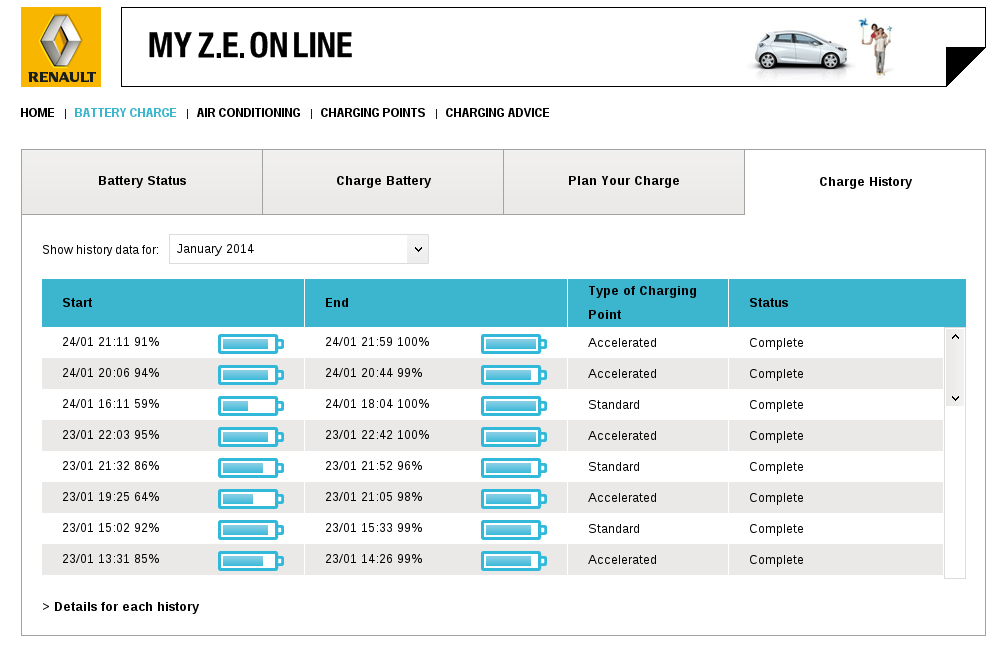
UPDATE: I thought I would show the charging information for this day. This is a screen shot of part of the Renault ZE services website where you can view this sort of data.
It's in reverse chronological order (latest at the top). You can see I had charged to 100% the previous day. When I arrived in Portsmouth the next day I was down to about 18% (not shown here). Then we drove to the fast charging point and got there with 12% left. We recharged to 83% before we left, next stop Basingstoke.
We actually charged twice at Basingstoke: I plugged into the charger and sat chatting to Nick whilst he looked up the train times from Basingstoke on his phone, and then unplugged and ran him to the railway station before returning to the charge point for a longer charge so I could get home.
Once I got home I was down to 10%. To charge from 10% to 100% on my home charger took just under 4 hours.
UPDATE: I thought I would show the charging information for this day. This is a screen shot of part of the Renault ZE services website where you can view this sort of data.
It's in reverse chronological order (latest at the top). You can see I had charged to 100% the previous day. When I arrived in Portsmouth the next day I was down to about 18% (not shown here). Then we drove to the fast charging point and got there with 12% left. We recharged to 83% before we left, next stop Basingstoke.
We actually charged twice at Basingstoke: I plugged into the charger and sat chatting to Nick whilst he looked up the train times from Basingstoke on his phone, and then unplugged and ran him to the railway station before returning to the charge point for a longer charge so I could get home.
Once I got home I was down to 10%. To charge from 10% to 100% on my home charger took just under 4 hours.
Saturday, 25 January 2014
EV Charging
Home Charging
There's a couple of schemes that seem to be running to facilitate the installation of a charging point at your home. I took advantage of the offer to have a free charging point installed by Chargemaster. I have higher capacity 30A unit which is attached to the outside wall of my garage.
![]() |
| Chargemaster Home Charging Unit |
In fact I did pay a small additional fee to get the higher-capacity unit, but they also fitted a new breaker panel in my garage as well. The higher capacity unit require a suitable electrical feed, but as I already had 40A cabling and breakers into my garage, the high capacity unit was available to me. The high capacity unit will fully charge the battery in about 3-4 hours. In most cases I will just be "topping off" the charge as my day-to-day usage is pretty low. The unit has a lock so it can't be used by random people driving past.
![]() |
| Charging Unit close up |
When the unit is unlocked, it will charge, but the cable, once inserted, is locked into the unit and cannot be removed until the charge unit is unlocked.
The Chargemaster installations are being done as part of a Government subsidy scheme. In return, you allow them to gather data on your charging. In fact anyone with off-street parking can have a free charger installed; you don't even need to have an electric car! The aim is to get EV owners to encourage their family, friends, and work locations to install them. I'm trying to get my parents to get one installed, so I can charge when I visit them.
The installed charge point includes a SIM which transmits status and usage data to the Chargemaster server. You also get a free Chargemaster RFID card which gives you access to any of the public chargers in their charging network (see below).
As well as Chargemaster collecting your charging usage data, they present it to you on a website:
![]() |
| Chargevision Web Site |
This includes details of usage of public charging points, like this one I used in the Bracknell Waitrose the other day:
![]() |
| Log of usage of public Chargemaster charging points |
![]() |
| Renault Z.E Services website status page |
![]() |
| Charge History |
Public Charging
As well has encouraging home charging, the UK Government has been encouraging schemes to install chargers in public places. A number of schemes exist including the Chargemaster/Polar network, which I get free access to for at least a year by having one of their home charging units, Ecotricity, and a number of local schemes in London which fall under the Source London banner. Most of these operate by having RFID unlockable chargepoints which you can apply for a card for. The public charging points are typically located at car parks of various types.
I've detailed a couple of the key ones.
Polar Network
This is the Chargemaster scheme which I currently have a free RFID card to use charging points all over the country. In my local town, Reading, there are at least 3 public points. Nearby Bracknell has a couple including this one I used in the Waitrose car park, whilst shopping:
Their website also has a map where you can locate chargers, and see the status of them:
![]() |
| Example of Chargemaster charging point map |
Ecotricity
Ecotricity is one of the large energy supply companies in the UK. They have a eoclogical emphasis compared with most of the other companies. Locally to me they have a large windmill which, amongst other uses, can be used by EV owners to charge their car.
| Ecotricity Windmill at Reading |
Ecotricity are also installing rapid charge points in many of the Welcome Break service stations on the UK motorway network. Rapid chargers will give you an 80% charge in around 30 minutes. The Ecotricity charging network is currently free to use.
![]() |
| Ecotricity Charge Point Map |
General
There are also a number of websites like ZapMap and some associated phone apps which give you details of local charging points.
![]() |
| Zap Map UK charging points |
![]() |
| Zap Map details of a charging point. |
So, as you can see, in the UK there are plenty of options for charging an Electric Vehicle.
Thursday, 23 January 2014
Renault Zoe "unboxing"
Today, after a few months of waiting, my Renault Zoe EV arrived.
I've been considering an EV for quite a while. A few years ago I was driving a ten year old, 4x4 Renault RX4 which was hardly "green". It had a 2 litre petrol engine and if I drove it carefully, I could get 45 MPG from it, but with normal driving I would be lucky to get 30 MPG.
![]() |
| My new Zoe, arriving on the transporter |
![]() |
| Zoe being unloaded |
I should point out I'm not a petrol-head in any ways. In fact I'm not fond of cars. My BMW, Merc, and Porsche loving neighbour wouldn't get this, but to me a car is simply a nice way to get from A to B.
I should also point out I do live in the country, as you can probably see from the photos, so a car is essential as the nearest town with a supermarket is about an hour's walk away. I need a car to do shopping, to get the kids to school and, in a lot of cases, to get to work. The 4x4 used to be genuinely useful, but hasn't really been in the last few years.
But, and this is the important bit, the vast majority of my journeys are under 10 miles. I rarely drive more than 20 miles in any given day.
We also have another car which runs on diesel which my wife uses. She commutes in it too but, like me, doesn't do journeys more than about 20 miles per day. If we need to do a longer journey, which is rare, we can use this car.
So, an EV is something I could use.
Of course, one of the major problems is cost. EVs have been considerably more expensive. However, with the current Government incentives, EVs like the Nissan Leaf and the Zoe are actually roughly the same price as equivalent cars. Sure there are cheaper cars, but that's not the point.
Another factor is that I run my own company. A lot of the travel I do is on company business but, as a director, if my company buys a car for me to use, I get stung with tax. Unless I buy an EV for, at the moment, the Government "Benefit In Kind" (BIK) for taxation purposes on EVs is... zero! So I don't pay any additional tax. I can also claim 50% of the VAT through my company.
So, with the cheap fuel, zero cost tax disc, no BIK, and 50% VAT offset, an EV makes a lot of financial sense.
I'm actually getting the Zoe on a 3 year lease as, currently, battery technology is improving by around 20% per year, and the costs of building EVs are also reducing year on year. I don't want to be stuck trying to resell a vehicle which is considered obsolete in a few years time. The lease allows me to refresh my car without such issues in 3 years time. I fully expect to get another EV then, but with improved battery capacity and range and maybe with the option of a range extender. You never know, there might even be some Hydrogen Fuel cell range extenders by then.
But for now, the Zoe is where it's at, and I'm loving it.
Of course, one of the major problems is cost. EVs have been considerably more expensive. However, with the current Government incentives, EVs like the Nissan Leaf and the Zoe are actually roughly the same price as equivalent cars. Sure there are cheaper cars, but that's not the point.
Another factor is that I run my own company. A lot of the travel I do is on company business but, as a director, if my company buys a car for me to use, I get stung with tax. Unless I buy an EV for, at the moment, the Government "Benefit In Kind" (BIK) for taxation purposes on EVs is... zero! So I don't pay any additional tax. I can also claim 50% of the VAT through my company.
So, with the cheap fuel, zero cost tax disc, no BIK, and 50% VAT offset, an EV makes a lot of financial sense.
I'm actually getting the Zoe on a 3 year lease as, currently, battery technology is improving by around 20% per year, and the costs of building EVs are also reducing year on year. I don't want to be stuck trying to resell a vehicle which is considered obsolete in a few years time. The lease allows me to refresh my car without such issues in 3 years time. I fully expect to get another EV then, but with improved battery capacity and range and maybe with the option of a range extender. You never know, there might even be some Hydrogen Fuel cell range extenders by then.
But for now, the Zoe is where it's at, and I'm loving it.
Subscribe to:
Posts (Atom)